Sunday, April 3, 2011


Sunday, March 13, 2011
Sunrise in the mountains

Sunrise in Asheville, NC
Taken with my iPhone
3/12/2011
Albert Einstein on Life and Love
Sometimes, in relentless efforts to find the person we love we fail to recognize and appreciate the people who love us. We miss out so many beautiful things simply because we allow ourselves to be enslaved by our own selfish concerns. Go for the man of deeds and not for the man of words for you will find rewarding happiness not with the man you love but the man who loves you more. The best lovers are those capable of loving from a distance far enough to allow the person to grow, but never too far to feel the love deep within your being. To let go of someone doesn’t mean you have to stop loving, It only means that you allow that person to find her own happiness without expecting her to come back. Letting go is not just setting the other person free, but it is also setting yourself free from all bitterness, hatred, and anger that you keep in your heart. Do not let the bitterness eat away your strength and weaken your faith, and never allow pain to dishearten you, but rather let yourself grow with wisdom in bearing it. You may find a peace in just loving someone from a distance not expecting anything in return. But be careful, for this can sustain life but never can give enough room for us to grow. We can all survive with just beautiful memories of the past but real peace and happiness come only with open acceptance of what reality is today. There comes a time in our lives when we chance upon someone so nice and soon becomes a part of our everyday lives and eventually consumes our thoughts and actions. The sad part of it is when we begin to realize that this person feels nothing more for us than just a friendship, we start our desperate attempt to get noticed and be closer but in the end our efforts are still rewarded and we end up being sorry for ourselves. You don’t have to forget someone you love. What you need to learn is how to accept the verdict of reality without being bitter or sorry for yourself. Believe me, you would be better off giving that dedication and love to someone more deserving. Don’t let your heart run your life, be sensible and let your mind speak for itself. Listen not only to your feelings but to reason as well. Always remember that if you lose someone today, it means that someone better is coming tomorrow. If you lose love that doesn’t mean that you failed in love. Cry if you have to, but make it sure that the tears wash away the hurt and bitterness that the past has left you. Let go of yesterday and love will find its way back to you. And when it does, pray that it may be the love hat will stay and last a lifetime. There are two ways to live your life. One is as though nothing is a miracle. The other through everything is a miracle.
There is no mistake so painful that love cannot forgive. no past so bitter that love cannot accept.
And no love so little that we cannot start all over with.
Love and Life by Albert Einstein. (1879-1955)
Friday, March 4, 2011
Thursday, March 3, 2011
Friday, February 25, 2011
MOMA: Curious works in the Museum’s rich collection.
Five for Friday, written by a variety of MoMA staff members, is our attempt to spotlight some of the compelling, charming, and downright curious works in the Museum’s rich collection.

The works have been selected. Handlers contracted. Opening parties and after-parties and after-after-parties arranged. It’s almost time for the cultural glitterati to come together and salute each other’s art (and, just as important, artful outfits). Yes, the Armory Show is nearly upon us!

Okay, so there are no gold statues, and no Angelina Jolie, but the Armory Show’s still a pretty big deal around these parts. New York’s foremost art fair has been held annually since 1999, but it has its roots in a show that happened almost a century ago, the Armory Show of 1913. If you took any sort of a modern art class in college, you know all about it: the show that alternately scandalized and sparked imaginations, introducing Americans to some of the most important art and artists of the modern period. (Physics and econ majors, don’t fret: the University of Virginia has a great site with a virtual tour.) Since so many of these works are now widely acclaimed as masterpieces, it’s hard to imagine how revolutionary this art looked at the time (or how reviled; Teddy Roosevelt reportedly declared, “That’s not art!”). But they’re still pretty wonderful to look at. So here, for a rainy Friday, is a look at five works in MoMA’s collection that appeared in the 1913 show (the actual works, or versions thereof).
Thursday, February 3, 2011
Edward Hopper at the Whitney

If the Whitney's admirable exhibition "Modern Life: Edward Hopper and His Time" doesn't do much to explicate its ambitious title, it still reminds us of Hopper's stature as a majestic and quintessential American painter. Originally assembled for and shown at the Bucerius Kunst Forum in Hamburg, Germany—a kunsthalle that invites foreign guest curators to develop exhibitions—and deftly organized by Whitney curators Barbara Haskell and Sasha Nicholas, the exhibition is a clever setup to remind us of the amazing wealth of the museum's holdings. In that sense, it's a not very subtle argument in favor of the Whitney's need for the expansive new Renzo Piano facilities currently being planned for the Meatpacking District.
 Josephine N. Hopper Bequest/Whitney Museum of American Art
'Woman Walking' (1906)
The exhibition's argument—that Hopper (1882-1967) and his contemporaries were rebelling against late-19th-century academic art and aristocratic portraiture in favor of a more direct confrontation with the world around them—is self-evident and hardly new to anyone who has spent time looking at American art, as is the show's uneven attempt to trace the development of American realism from 1900 to 1940.
On the other hand, the exhibition is an opportunity to gain a sense of the Whitney's origins and the development of its collection: It reminds us of the commitment founder Gertrude Vanderbilt Whitney had to American artists in a culture that still tended to believe that all serious artistic endeavors had to come from Europe. Ironically, Robert Henri's iconic 1916 portrait of Whitney demonstrates the difficulty of severing connections with traditional concepts; the elegant young woman in a provocative Venus-like pose wears a very modern casual shirt over pants, but we're never fooled into believing that this is anything other than an updated version of a Giovanni Boldini or John Singer Sargent society portrait.
Continued here........
Continued here........
Friday, January 21, 2011
Now showing at the Metropolitan Museum of Art : Important Photographers

WHO: Alfred Stieglitz, Edward Steichen, and Paul Strand
WHAT: 'Stieglitz, Steichen, Strand'
WHEN: November 10, 2010 - April 10, 2011
WHY:
Stieglitz, Steichen, Strand features three giants of 20th-century American photography whose stories are interwoven: Alfred Stieglitz, Edward Steichen, and Paul Strand. The groundbreaking work of these artists is revealed through a presentation of 115 photographs, drawn entirely from the Metropolitan Museum's collection. Among the highlights are: Alfred Stieglitz's famous portraits of Georgia O'Keeffe; Edward Steichen's large colored photographs of the Flatiron building; and Paul Strand's pioneering abstractions.
Monday, January 17, 2011
Fiber pot/ box


Approximately 1/2 activated carbon, then add pieces, cover with about 1.5 inches of carbon. The large piece (ginko leaf) is about 2.5 inches, all other pieces about 1.5 to 1.75 inches. There is room for a couple more pieces...I just didn't have any more pieces prepped and well dried.

View of fiber box in kiln...ready for firing. I fire with an open top.
Sunday, January 16, 2011
January 16, 1966 On this day

Wednesday, January 12, 2011


Monday, January 10, 2011
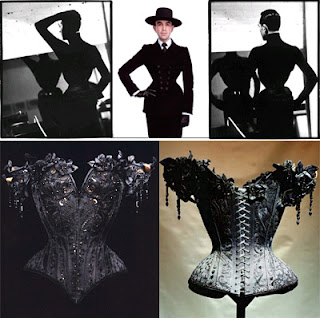
Corsets
A male friend was recently lamenting the decline of real 1960's and earlier garter belts. I was surprised to find that true corsets, with garters attached are still around. I think I need one or two.


Thursday, January 6, 2011
Bronze Ginkos

These are made from a bronze clay I compounded. The molds are made with Ginko Biloba leaves harvested on Wall St, in downtown Asheville. In real life, they have a beautiful soft iridescent patina. (almost pastel).....not captured by the camera.
Tuesday, January 4, 2011
480 million year old rock
The curving lines in this rock indicate enormous pressure.
 Geology of the Appalachians
Blue Ridge Mountains
Blue Ridge Mountains
Monday, January 3, 2011
Mos Way Sunrise: Love Like That

Mos Way Sunrise: Love Like That: "Thank you, @primalmarks... 'Even After all this time, The sun never says to the earth, 'You owe Me.' Look at what happens With a love like..."
Enough of the foolishness

Sunday, January 2, 2011

Angel biscuits with sweet potato
You can embellish the basic recipe with any number of ingredients, from savory to sweet. Cheese, jalapeno, onion, sweet potato, pumpkin, raisins, blueberries, etc. I porked out from eating blueberry biscuits from Popeyes. I used to take the St Charles streetcar to the edge of the French Quarter in New Orleans, back in the '80. There was a Popeye's as I boarded the streetcar, and every morning I had to have a blueberry biscuit. Thankfully they stopped making them after I'd gained about 25 pounds on the delicious morsels. BTW, Paul Prudhomme says Popeye's has the best fried chicken, but get it on Thursday when they change to fresh oil
INGREDIENTS:
2 1/2 cups all-purpose flour preferably unbleached 2 tablespoons white sugar 1/2 teaspoon baking powder 1/2 teaspoon salt 1/2 cup shortening | 1/4 cup warm water (110 degrees F/45 degrees C) 1 (.25 ounce) package active dry yeast Add a pinch or two of sugar to "feed" the yeast and add to buttermilk when it's gotten very foamy. 3/4 cup warm buttermilk (105 to 115 degrees F) |
DIRECTIONS:
| 1. | In a large bowl combine flour, sugar, baking powder, and salt. With pastry blender or two knives, cut in shortening until mixture resembles course crumbs, set aside. |
| 2. | Place warm water in warm bowl. Sprinkle in yeast, stir until dissolved. Add yeast mixture and warm buttermilk to dry ingredients, blend well. |
| 3. | Remove dough to floured surface. Knead dough 10 to 15 times, form into ball. Roll dough to 3/4 inch thickness. Cut into 2-1/2 inch biscuits. Cover and let rise until doubled in bulk, about 30 to 45 minutes. |
| 4. | Bake at 400 degrees F (205 degrees C) for 15 minutes or until done. |
Saturday, January 1, 2011
My gumbo video
Click on the link to view
I made a fabulous gumbo using smoked turkey and the turkey carcass for the stock. It's my best gumbo yet. We had open house for friends and everyone raved...course that's all a cook wants.
Click on the link to view
I made a fabulous gumbo using smoked turkey and the turkey carcass for the stock. It's my best gumbo yet. We had open house for friends and everyone raved...course that's all a cook wants.
Subscribe to:
Posts (Atom)